Hi Gayle ... posting videos here is kinder a 'you show me your's, I'll show you mine deal' ... they're gonna rag on ya till you do it, might as well get yer feet wet ... so to speak ........ welcome to FOTMD
Forum Activity for @sam

 in our own little way. Get my drift? LOL Glad you are enjoying the site.And if you really want to see how "SPECIAL" we can be check in to chat
 some evening.Welcome to FOTMD. Dana

Gayle ! I echo what Brian has said, particulary the bit about seeing some videos from you, from my experience they will be well received, those who post are very varied in ability and allow great learning potential !
JohnH
ps. I am afraid that there is at least one photo of me wearing a tuxedo posted here, please do not hold that against me 

Welcome to our little corner of musical Paradise.
Why? Maybe because we're fans of an unusual instrument with an interesting history. Maybe it's because we like 'rooting for an underdog'. Maybe it's because we like being 'different'. Somehow the dulcimer just isn't as pretentious a classical guitar or violin. Not as set in its ways as a banjo or mandolin.

It's good to have you be a part of FOTMD, Gayle!
Websites tend to have, for lack of a better word, personalities. I have met many wonderful folks both here at FOTMD and at another site where I'm a member, Everything Dulcimer. I think there's an indescribable something about the mountain dulcimer that draws many folks to it who just happen to be friendly.


Photos Dulcimer Factory c. 1995 DF-4
General mountain dulcimer or music discussions
It's been some time since you posted yourvintage 1995 dulcimer. I was wondering if you still like it, I came across one much like it, 1996 one. I'm not sure I like the bright sound, hope I will like you after a few days.
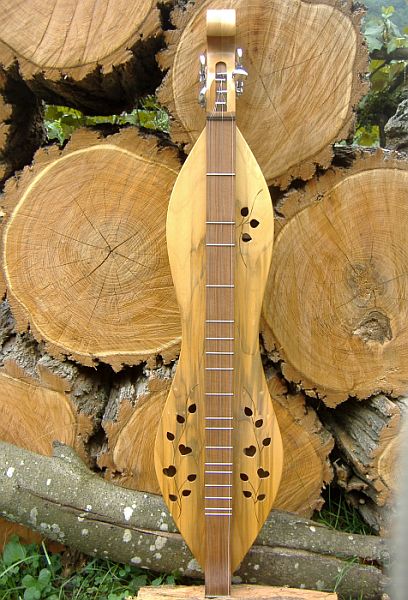
I am new to this web site and to trying to play the dulcimer, I would like to send you a photo of the DF dulcimer I have. It is very much like yours but different wood and where you have leaves like a heart, mine are all leaves.
Wait, maybe I just figured out how to send a photo.
I'm open to info you have learn in playing your DF dulcimer.
thanks,
marg.
Photos Dulcimer Factory c. 1995 DF-4
General mountain dulcimer or music discussions
Hi Mary ... I actually did 'sniff' it :). There is no discernible aroma of sassafras or root beer ... sadly. There's really not much smell at all so I guess the previous owner was not a smoker. The dulcimer was bought by a son and his wife for their mother. She never played it. Story is that they are now helping her dispose of quite a bit of her personal things because of the economy. The dulcimer was made in 1995 but looks in new condition. The wood's color is just amazing and I'm very happy with it. Sounds good too.
Photos Dulcimer Factory c. 1995 DF-4
General mountain dulcimer or music discussions
But does it smell like root beer ? :)
Photos Dulcimer Factory c. 1995 DF-4
General mountain dulcimer or music discussions
In the books that came with the dulcimer I found the original generic sales pamplet that came with the dulcimer when it was originally sold. This model was only offered in sassafrass/walnut or one other combo that I don't remember ... it's not the other, so it's sassafrass.
Photos Dulcimer Factory c. 1995 DF-4
General mountain dulcimer or music discussions
Sassafrass usually only smells until it is aged. My cherry/ sassafras dulcimer smelled like root beer for about 5 years -- wonderful. :) my walnut/ sassafras never had the smell, but suspect it was older aged wood. Have a Spanish curly cedar/figured mahogany that kept the Spanish cedar smell for several years-- it was kind of a peppery wood smell-- but so many folks smelled it-- they finally just sucked all the smell out of it :)Really loved the root beer smell on the sassafras, though :)
Photos Dulcimer Factory c. 1995 DF-4
General mountain dulcimer or music discussions
You have a good point Paul. I haven't noticed any smell when I open the case. I remember the sassafras smell really well from the hayloft in the barn. It smelled so good. I still make tea real often.
The back has more 'birds eye' or tiny, tiny knots than the photo shows and they all have a pronounced reddish tint. I don't know what the wood is, but it's very nice.
Photos Dulcimer Factory c. 1995 DF-4
General mountain dulcimer or music discussions
Don't scratch it, just sniff close to the sound holes. My sassafras dulcimer still smells of root beer after 22 years, though not as strong as when it was new. As soon as I open the case I get a whiff of it. It looks a little pale for sassafras, though.
Paul
Photos Dulcimer Factory c. 1995 DF-4
General mountain dulcimer or music discussions
Hi Wayne ... the dulcimer looks very good and I'm ecstatic about it's being solid wood instead of a veneer. I think I am most impressed with the construction though. It is put together VERY well. All glue joints are tight and even. The fit and finish are really good.
Ken ... good idea on the scratch n sniff. I looked at pictures of all their dulcimers and it looks most like the ones they did from sassafras. What I meant was that I'm totally ignorant about sweet gum (there's lots one state away, but not here), so I thought that it might be a possibility as they (the Naylors) did use some of that. The family that bought it originally for their mother were very kind and gave me all the info that they could when I contacted them but they did not remember the kind of wood that was used.
Carrie ... the back is bookmatched and both front and back have more color and character than the pics show. At first tuning and strumming the strings ... I hated it ... but that was my ear. I had nothing to compare it to but my home made dulcimers. After just a short time though, I recognized what a lovely sound it has. I like it very much now.
Photos Dulcimer Factory c. 1995 DF-4
General mountain dulcimer or music discussions
Could be Sweetgum, but if so, it haslots of character. You could always "scratch & sniff" on an out of the ay place inside, and see if you get the characteristic Sassafras aroma. That's what it looks most like, to me - flat sawn Sassafras.
Photos Dulcimer Factory c. 1995 DF-4
General mountain dulcimer or music discussions
Thanks guys, I'm very happy with this dulcimer. I wish the pics showed it as pretty as it really is. They don't.

Photos Dulcimer Factory c. 1995 DF-4
General mountain dulcimer or music discussions
Aw Sam, that is a nice lookin dulcimer. Beautiful! Nice find for sure. Jury's still out as to what kind of wood it is.
updated by @jim-fawcett: 01/24/16 12:57:21AM
Photos Dulcimer Factory c. 1995 DF-4
General mountain dulcimer or music discussions
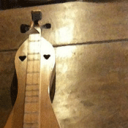
I hadn't taken pics of the DF-4 I recently purchased.
I was satisfied at $150.00 for the veneer utility model I thought I would get. When it came, it is a vintage 1995 that is SOLID wood and absolutely beautiful. It had never been played and looks brand new. It came in a hard case with books, papers, a big book of tab, pics, strings and a noter. There is not a scratch on it anywhere. The label does carryJohn and Shirley Naylor's name.
I'm not sure on the wood. In research they used a lot of sassafrass during the time this dulcimer was built. I'm not familiar with sweet gum so it could be that. Any help in positively identifying it would be most appreciated. The sides and fretboard are walnut. It is a dream to note and sounds as good as it looks.
updated by @sam: 08/03/23 03:34:34PM
Mixed, compatible tunings.
General mountain dulcimer or music discussions
Robin, you are correct that the modal songs are almost all in G or A. Except when dulcimer players get together sans fiddle and banjo players. I have known a number of dulcimer players to play Old Joe Clark, Shady Grove, Cluck Old Hen and other tunes in D. Fiddler and banjo players cringe at this, as some of these songs are uncomfortable in the wrong key. I used Old Joe as an example simply because I have seen it played in D in a number of dulcimer jams.
Skip, your 646 chord is a C major, but the melody note for Old Joe at this point requires a C on the melody string. 646 in DAA gives you CGG, with a G on the melody note. You can play a chord backup to someone else playing the melody, but you can't get your melody unless you play the whole melody on the bass string. If you practice this, it can be done. It's an incomplete chord, missing the 3rd, E, but with only 3 notes available, we use partial chords a lot. If we intend to use one of our strings for melody, the 2 that are left end up playing partial chords pretty often. Any time the melody uses a note that isn't part of the chord we have a partial chord playing with that note.
Paul

Mixed, compatible tunings.
General mountain dulcimer or music discussions
The root is the first note of the scale and is usually tuned on the bass as in DAA, DAd, CGG or CGc, GDD or GDg. These tunings would be shown numerically as 1-5-5 for DAA, CGG or 1-5-8 for DAd or CGc. The middle string is then tuned to the 5th note of the scale.
However, people do use other tunings to play in certain keys as they are easier to tune with the string gauges that are on their dulcimers. Since I normally tune to the key of C Ionian or CGG/ 1-5-5, it is easier for me to tune my C bass string up one note to a D if I want to play in the key of G, instead of having to change string gauges to get GDD. I leave the middle and melody alone so I still have G drone and a D drone, but my beginning scale note is now on the open melody string. I can play 1-5-8 tab by playing the lower notes on the bass string rather than the middle. Some people play A by doing the same thing but by going from DAA to EAA.
If someone is in DAd then going down on the middle string one note to G gives them G in what is known as reverse Ionian or DGd. You'll see this tuning frequently in tab as it's becoming more popular.

Mixed, compatible tunings.
General mountain dulcimer or music discussions
Thanks everyone! I reallyappreciate all of the input.
Mixed, compatible tunings.
General mountain dulcimer or music discussions
Modal Tuning, may be my phrase.
Historically the word Mode goes back to the Greeks and the Monochord (one string) instrument. A Mode is a scale on a single string - the Melody string. The dulcimer has two drones which accompany the Melody. Those drones are almost always in a 1-5 relationship. A Modal Tuning would be the combination of drones and melody string notes for playing in a particular Mode - DAA or CGG or GDD are all Ionian Modal tunings where the scale (in D, C or G) starts on the 3rd fret and walks up to the 10th. DAd, CGc, GDg are Mixolydian Modal tunings where the scale starts on the Open note and goes to fret 7. Thus I can write "All Ionian Modal tunings share common tabulature."
Mixed, compatible tunings.
General mountain dulcimer or music discussions
Thanks Robin;
Adefinitionthat is in non-music terms clears up a lot for me. I can work out the best way for me to backup/harmonize.
'the root and/or 5th of the scale being played' is the key of the tune, or open bass string, or????

Mixed, compatible tunings.
General mountain dulcimer or music discussions
In 'dulcimer speak' we usually refer to modes just as a scale on the melody string supported by appropriate drones (drones being the root and/or 5th of the scale being played). This is not the musically correct way to define modes but it is a very useful nomelculture for noter/drone dulcimer players. This is because we have to retune not just to the key of a tune but to the modal scale within that key - and very few other instruments have to do this.
So, basically, if I/we want to backup/harmonize, or even play straight melody, using a different tuning, I/we would probably have a greater chance for success by xxx/chording, rather than xxx/droning, and rhythm.
Actually - No. It is very easy to get into the correct key and mode for most folk music playing noter drone - and play effective back-up and harmony. Chord melody can work out more complex.
Mixed, compatible tunings.
General mountain dulcimer or music discussions
Could you define a 'mode tuning' for me? It looks to me, after really studying Pauls post, with dulcimer in hand, that a 'mode tuning' is having all of a modes notes available on the melody string, rather than having them available on any string. [I tuned my MD to DAA and found a C major at 6-4-6.]And, probably something about the other strings not clashing? If this is the case, it makes many of the things I've read more understandable since I look at all of the notes available, not just the ones on the melody string.
Just a note; I've spent days n days, and a lot of paper, working on the relationship of keys, modes, and fretboard, which I don't have a problem with now. It's the mode tuning , not modes on one string, that gives me heartburn.
So, basically, if I/we want to backup/harmonize, or even play straight melody, using a different tuning, I/we would probably have a greater chance for success by xxx/chording, rather than xxx/droning, andrhythm.
Mixed, compatible tunings.
General mountain dulcimer or music discussions
Blimey!!!!! I'm with Robin T here. I tune my dulcimer to what sounds right when playing with other folks and then work out what my tuning/mode actually is after I've finished playing  So my music 'theory' tends to be reverse engineered based on what's actually happened
There's no problem with different instruments being in different tunings - as long as the sound all fits together.
Incidently - I've never come across a traditional Appalachiantune in the key of D mixolidian? All the mixolidian ones tend to be in the key of A. Easy for D,A,A players as we just tune to E,A,A. But I've never seen the D,A,dTAB for "Old Joe Clark" in the right key. However, not knowing any better, "Old Joe Clark" was one of the first tunes I learn't on mountain dulcimer, tuned D,A,d and played chord melody style in the key of A because that's the key everyone I knew was using(banjo, fiddle, mandolin, guitar etc). I just worked it out by ear from 1,0,1 as a starting point.
And I think that this is the major point about mixed compatible tunings. Don't think just in terms of playing with other dulcimers, think in terms of playing with other instruments (dulcimers included) and you'll find it is not rocket science to pretty much switch to any key or mode desired - particularly when working with the traditional Appalachian repertoire.
Mixed, compatible tunings.
General mountain dulcimer or music discussions
More rarely used, but all in keeping with the above, are the aeolian and dorian modes. These are two minor keys(the 3rd, Mi, is flatted.) The only difference between aeolian and dorian is, again as in ionian/mixolydian, the 6th is flatted in dorian and natural in aeolian. So similar changes occur, slightly complicated by the flat 3. With new notes in the scale, new chords are possible, and some we had before are unavailable. That's why we use modal tunings to play songs in different modes. Playing with drones we simplify this by not needing to look for chords to harmonize the melody. But our DAA or DAD chord players will clash with our DAG or DAC drone players. This is why Tabs always tell us what tuning we need with the tab. Standard sheet music is written with the idea that we have chromatic instruments. Modes are not noted anywhere in SMN. The chords, if they are written above the music, are the best indicator of the mode we need to play the song. We then need to know what chords are possible in a given mode.
Paul
Mixed, compatible tunings.
General mountain dulcimer or music discussions
Here's the problem: When you tune to 158, the ti flat note is at the 6th fret. But when you change that tuning to 155, the 6th note of the scale is now at the 1+ position. If you don't have the 1+ fret, you can't play mixolydian songs in the ionian tuning. You will find some mixolydian tunings that only use 5 notes of the scale, but one of those 5 notes will always be the 6th note of the scale. I challenge anyone to find an exception to this. Further, mixolydian songs, when harmonized with chords, use a curious chord built from the seventh note of the scale. In the key of D mixolydian, this odd chord is C major. Modern music theory tells us the key of D contains no C major chord. The ionian scale of D has a C#, so there is no C major there. The ionian chord in this case is C# diminished. It contains C#, E, and G. Modern music theory calls this a DISCHORD, rather than a chord. When the DAA player plays this dischord against the DAD players C major chord, the true meaning of cacophany really shows through. Put this into a true mixolydian song, such as Old Joe Clark. In DAD, we have a true C major chord to play at this point in the song, and it harmonizes perfectly. DAA players need the C natural at the 1+ or 8+ fret to make this C chord. Lacking that, most use A major, or A7. But either of these contains the offending C# note. If either of these is played against the DAD players C major, the C and C# clash. The strongest dissonance in music is to be 1/2 step away from correct. In other words, the C# is more dissonant than D would be in the same situation. And in DAA or DAD, one of the drones is D. That's why the drone doesn't clash with the C major chord. Adding a D to the C chord makes it a C suspended 2. A little jazzy, but not dissonant. The other drone is A. A added to the C suspended 2 gives us C6 susp. 2. Again, jazzy, but not truly dissonant. It doesn't clash. This is why I said yesterday that when playing chords it could cause problems. The drones are D and A in either tuning. No clash at all.
The chords follow the scale, and each mode is it's own scale. Only one note is changed as we go from Ionian to Mixolydian, the C# of the Ionian becomes the C natural of the Mix mode. But the common A chord from the D ionian scale is no longer available. We now have three chords we didn't have in the ionian mode: C major, instead of C# dim Am instead of A major, and F# b5 instead of F#minor. The chord harmonies of this mode use the chords available with this mix scale, though I can't recall seeing the F# b5 used in folk music. A lot of mix mode songs in the key of D use only 2 chords, invariably it is the D and C chords. More often, mix songs will use 3 chords, the D, G, and C chords. The Am is somewhat more rare. A 2 chord Ionian mode song in the key of D will use D and A or A7. 3 chord songs will use D, G, and A/A7. (I am speaking predominantly of folk music, Jazz based songs are the rattle snakes of music; they go where they want and no one tries to stop them! )
)
Paul
Mixed, compatible tunings.
General mountain dulcimer or music discussions
Yep, My idea is to avoid having to learn different fingering patterns for the same song in different keys but just one tuning. I have enough trouble learning a single melody line for a song as is.  But with retuning I can use what I do know but in different keys. So different strokes for different folks. All's good.
And by staying in an Ionian tuning for songs that are in the major scale, I avoid having to skip over to the middle line for the lower notes. I do so hate trying to finger dance on the middle string. No problems using the bass line for really low notes, but I flub up on the middle constantly. Go figure?
Skip said:
Many keys, many tunings, one tab; Many keys, many tabs, one tuning.Different approaches for different goals.
I really don't like to retune, lazy I suppose. I have enough dulcimers to tune each to a different 1-5-8 but I only take one or two south with me.
I'm also getting to appreciate more and more the basic bass players approach,rhythmand one note chord backups.
Mixed, compatible tunings.
General mountain dulcimer or music discussions
Many keys, many tunings, one tab; Many keys, many tabs, one tuning.Different approaches for different goals.
I really don't like to retune, lazy I suppose. I have enough dulcimers to tune each to a different 1-5-8 but I only take one or two south with me.
I'm also getting to appreciate more and more the basic bass players approach,rhythmand one note chord backups. They do fancy stuff also but I don't know that I'll ever go there.
Mixed, compatible tunings.
General mountain dulcimer or music discussions
Skip, What I'd do (and just did) was look up Wildwood Flower at Digital Traditions as I don't have it tabbed out, or didn't have it tabbed out.
http://sniff.numachi.com/lookup.cgi?ds1=G&ds2=G&ds3=C&t...
Now with this tab, I can learn to play just one version of Wildwood Flower and yet play it in any key I can tune to. I normally play CGG, so DAA is just as easy as is AEE or GDD on my baritone. Ccc would also be possible on the dulcimer that I've got strung for Bagpipe tunings. One tab with many keys.
Mixed, compatible tunings.
General mountain dulcimer or music discussions
I kind of do the same thing since I don't really read music as much as translate it to tab. I can find numbers faster than notes though not at playing speed.
I tabbed Wildflower to 4 different keys for the DAdd tuning one time and it worked out ok. It's played on different areas on the fretboard.
Mixed, compatible tunings.
General mountain dulcimer or music discussions
Skip - Modes are scales, plain and simple.
The one we all know - do, re, mi, fa, sol, la, ti and do again - is the Ionian Mode scale
The Mixolydian Mode scale is - do, re. mi, fa, sol, la, ti-flat, and do again.
- If your dulcimer has the 6+ fret you have both the ti and the ti-flat note whether tuned in DAd or DAA
- If you dulcimer does not have the 6+ fret and you're in DAA you only have the ti note.
- If your dulcimer does not have a 6+ fret and you're in DAd you only have the ti-flat note.
Mixed, compatible tunings.
General mountain dulcimer or music discussions
Skip, I'm in total agreement with "the everyone would sound alike part" being a boring idea too. I understand the question you were posing now. If someone wants to use a melody that they know in a DAA format but they are tuned to DAd, it just isn't going to work. The player would have to do a subtract 3 so that the tabbed numbers would fall on the correct fret. A DAA 9th fret comes up as a 6+ fretting in DAd using subtract 3. No matter how you tune, you have to know where the scale starts.
I do my own tabbing since most of the music I play isn't a regular part of the dulcimer repertoire and I use just a fret number to indicate what note to play. I'll use SMN to get my fret numbering then I discard the SMN and use the tab. Since I know what mode I'm suppose to be playing in, I can choose the key I want to play and still use the same tab. The tab acts as an instant transposing tool as I tend to play music in lower keys than say the SMN has indicated.
Mixed, compatible tunings.
General mountain dulcimer or music discussions
Skip,
When Rob Lackey and Kevin Messenger, and I met and jammed for a few hours at Cooper's Rock in good old WV. I played in DAA (noter & drone) and Rob did finger dancing on the other dulcimer(DAD) and Kevin on the Dulci Banjo tuned DAD also. It sounded great, and no one complained about my drones... in fact Rob did a medley playing noter and drone. When we were jammin, it really bother me that they were in anothercompatibletuning. It blended together nicely.
Mixed, compatible tunings.
General mountain dulcimer or music discussions
I heartily agree, Skip-- it's great to hear variety in the play of a tune! When I'm playing fiddle tunes with friends, I like to play through the tune several times, varying something here or there. Fortunately, I have musician friends who also like to play through fiddle tunes several times and they vary their play also.
Skip said:
Robin;
Watched your video's, we liked them. That is generally where I am aiming to go.
Folkfan; I agree with that. [Except for the modes part, which really doesn't mean as much to me as note availability. I leave that up to the writers/TAB producers and assume they know what they're doing.] The 'everyone would sound alike' is the part which bothers me, it's so sterile sounding [and ultimately boring] to hear everyone playing exactly the same thing. It's part of the reason for the original post.
Mixed, compatible tunings.
General mountain dulcimer or music discussions
Oh, got ya, Skip! It was my fault for not understanding-- I'm an idiot about music!
Skip said:
Robin;
The question is based on Paul Certo's post about a player playing a DAA tabbed tune in DAdd. That player was 3 frets off of the SMN notes. In other words, when the tab indicated a DAA 3 {d} on the melody, the player was playing a DAdd 3 {g, s/b 0 [d]}. That's why it seems to me you should pay attention to the notes even if using TAB [Tab positions the fingers to the fretboard, not the notes].
Mixed, compatible tunings.
General mountain dulcimer or music discussions
Robin;
Watched your video's, we liked them. That is generally where I am aiming to go.
Folkfan; I agree with that. [Except for the modes part, which really doesn't mean as much to me as note availability. I leave that up to the writers/TAB producers and assume they know what they're doing.] The 'everyone would sound alike' is the part which bothers me, it's so sterile sounding [and ultimately boring] to hear everyone playing exactly the same thing. It's part of the reason for the original post.